
RECOMMENDED VIDEOS
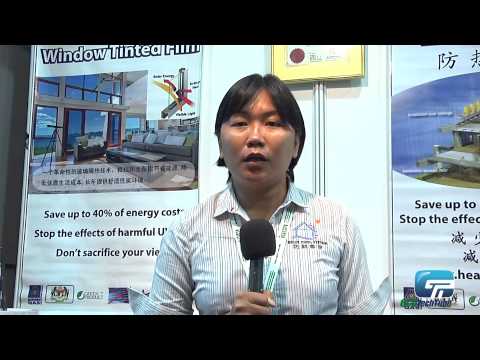
Heat Shield Solution: Roof & Wall Insulation, Glass…
Heat Shield Solution

Tire Log™ New Green Building Material
Re-Tread Products, Inc.

M & C Engineering : LOYTEC Room automation with L-ROC
M & C Engineering and Trading Sdn Bhd
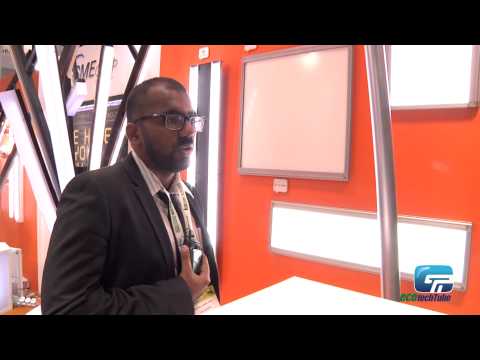
Green Energy Alliance : Manufacturing LED Lighting - Energy…
Green Energy Alliance Sdn Bhd

IRIS Smartpot : self-watering pot that takes care of your…
IRIS Corporation Berhad
Related Stories
‘House of Trash’ proves how waste can transform into beautiful home design
Whimsical park built of recycled materials pops up in Shanghai
Elevated bamboo peace bridge for the Korean Demilitarized Zone unveiled by Shigeru Ban and Jae-Eun Choi
Colossal cardboard temple pops up in Chiang Mai in just one day
“Cannabis walls” add warmth to this eco-friendly home in Israel
20 Jul, 2016

A beautiful perforated facade shields this office from India’s harsh sun
Green Building Materials, Construction & Design | INDIA | 20 Jul, 2016
Published by : Eco Media Asia
Studio Symbiosis recently unveiled plans for the Punjab Kesari Headquarters, an office in Delhi NCR that blends contemporary design with traditional Indian architecture and an energy-efficient envelope. The sculptural building is wrapped in a beautiful perforated facade that evokes traditional “Jali” screens and serves to maximize natural light while minimizing heat gain.
The Punjab Kesari Headquarters is currently under construction, however, the International Property Awards has already designated the design as Winner Best Office Architecture India 2016-7. Set on the corner of an intersection, the 18,000-square-meter office space was created with the objective of reducing heat gain and maximizing natural light to the point that no artificial lighting would be needed on the typical day. Its white, glass-reinforced concrete facade, which looks like a veil inspired by traditional Indian decorations, is punctuated by different sized openings informed by solar orientation and digital simulations. The north facade, for instance, has a 81% opacity as compared to the 27% opacity on the south side.
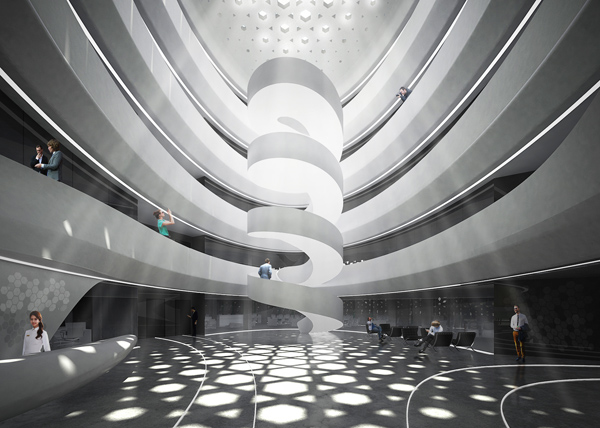
“Sustainability is at the epicentre of the project embedded in form of, optimized natural lighting, cross ventilation and reduction of heat gain,” write the architects. “The double jali screen reduces the outside air temperature in front of the glass. The colder air is going in and pulled into the atrium through the chimney effect of the atrium space and resulting in natural ventilation and reducing the indoor air temperature naturally so the cooling load for the air conditioning is reduced.” The project is slated for completion by January 2017.
Images via Studio Symbiosis
Article by Lucy Wang at inhabitat.com