
RECOMMENDED VIDEOS
Ecoheet - Energy Saving Solutions for commercial buildings
EcoHEET Sales & Services Sdn Bhd
Guangdong East Power : On-Grid, Off-Grid Solar, Hybrid…
Guangdong East Power Co.,Ltd.
The Future of What's Left Behind: Cellulosic Ethanol…
Abengoa

Starlight® Energy Management Solution - Powered by…
Anacle Systems Sdn Bhd

Introduction of Biogas digester - The Little Green Monster
ENERGYWEB Stella Weber
Related Stories
The City of London will be powered with 100% renewable energy by October 2018
The largest solar farm apiary in the US opens this week
New study suggests that plastic waste may be transformed into usable energy
Uravu’s zero-electricity Aqua Panels produce gallons of water from thin air
104% of Portugal’s electricity consumption in March came from renewable energy
24 Jul, 2016

Sonnen Launches a Home Battery for Self-Consumption at a 40% Reduced Cost
Renewable Energy & Energy Efficiency | GERMANY | 22 Jul, 2016
Published by : Eco Media Asia
The “eco compact” is designed to maximize on-site solar consumption in markets where net metering is getting phased out.
The German battery company Sonnen is preparing for a world without net metering.
Today, the company released a new home battery product designed to maximize on-site energy use. It also comes at a price point 40 percent below Sonnen’s existing residential energy storage system.
"We expect to see a dramatic increase in the installation of storage across the country," said Boris von Bormann, CEO of Sonnen, Inc., in a statement.
“[The eco compact] is really aimed at those emerging self-consumption markets, markets where net metering is being taken away or changed, such as Arizona, Nevada and Hawaii,” he elaborated in an interview. “Or where utilities are looking to deploy a product in more areas at larger scale for the grid services market.”
The eco compact is outfitted with Sonnen’s self-learning software to provide various grid-tied functions, including increased household solar consumption, the ability to manage time-of-use rates, and supporting ancillary services. However, unlike the eco protect -- the home battery that Sonnen currently offers -- the compact system does not include off-grid functionality.
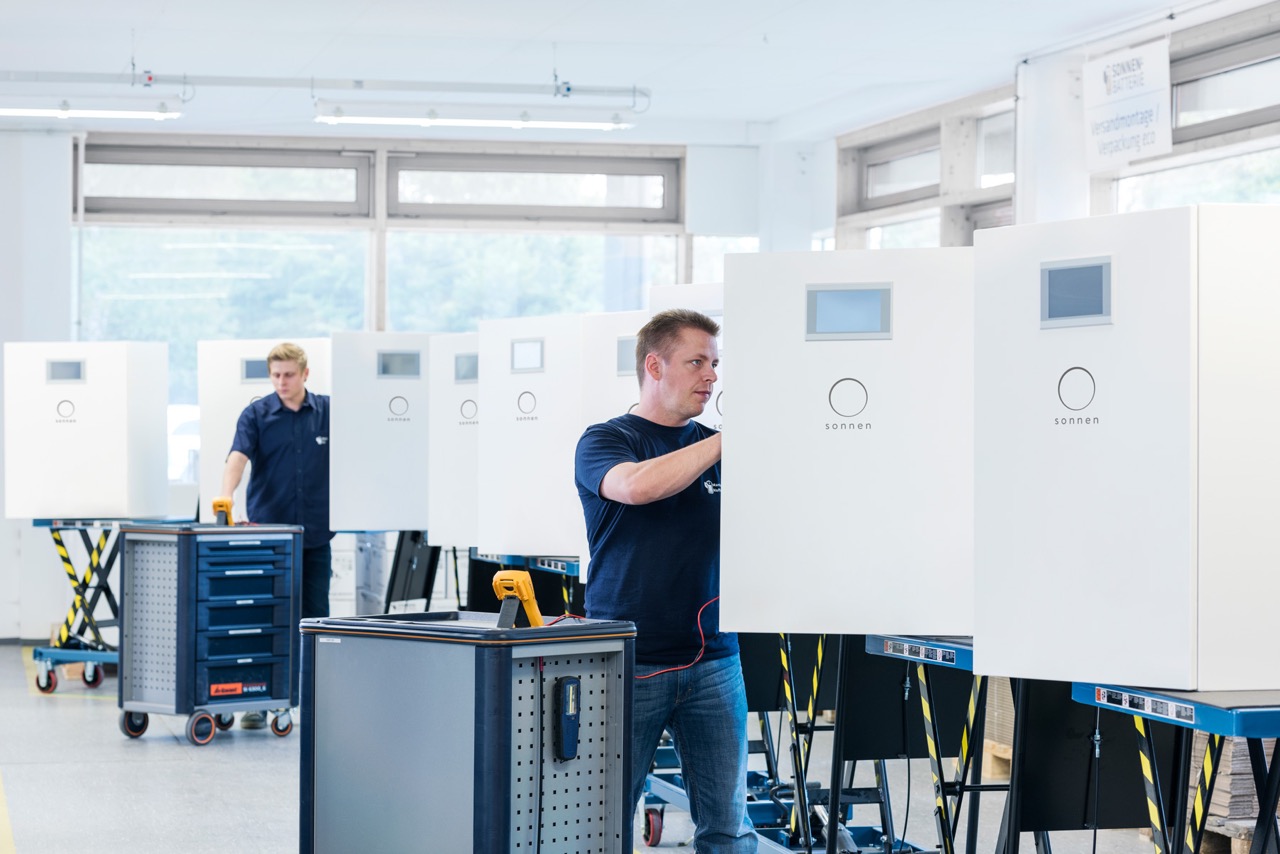
Sonnen was able to cut the cost by removing the backup power features, and by leveraging the company’s scale and engineering experience from having deployed more than 12,000 residential systems to date.
The fully integrated 4-kilowatt-hour eco compact system retails for $5,950 plus installation, which can range from an additional $500 to $3,000, depending on the customer. The lithium-iron-phosphate battery comes equipped with an inverter and Sonnen’s smart energy manager, as well as a warranty for up to 10,000 cycles. In addition, the modular design allows the compact system to be easily expanded in 4-kilowatt-hour increments, up to 16 kilowatt-hours in a single unit.
Because of the outage risk from storms, earthquakes and technical grid issues, von Bormann believes there will always be demand for batteries that provide backup power. But the case for self-consumption is growing. Just last month, Maui Electric Co. announced that customers have hit the cap for the number of rooftop solar systems that can send excess power to the grid under Hawaii’s new rate structure. Going forward, customers will have to connect under the self-supply tariff, which should encourage customers to buy battery systems.
Island locations with high electricity prices are target markets for the eco compact, said von Bormann. Sonnen is also looking at opportunities in Nevada, where regulators recently approved a phase-out of net metering, and it is also focused on Arizona, which is poised to see the net metering credit reduced and could see the introduction of universal demand charges. Von Bormann said Sonnen is already in contact with Arizona Public Service and is looking for opportunities to participate in the utility’s distributed energy innovation pilots.
In California, San Diego Gas & Electric recently became the state’s first utility to meet its net metering cap, and thus will move to NEM 2.0 where PV customers will continue to receive a net metering credit, but must transition to time-of-use rates. Adding in California’s self-generation incentive program, which is about to relaunch with a 15 percent carve-out for residential systems, “the value proposition becomes highly, highly attractive,” von Bormann said.
Sonnen doesn’t support or oppose any particular solar-related policy -- be it net metering changes or demand charges, he added. He believes it’s important to continue supporting solar as much as possible in order to drive down cost, but it’s also important to consider that storage can provide an unparalleled value stack when combined with solar and other services.
Images via Sonnen
Read full story at Greentech Media
Article by Julia Pyper
Article by Julia Pyper