
RECOMMENDED VIDEOS

NEUTO Dry Hydrogen Auto-Therapy - Channel 8 News
Neutrinos
Hybricon Bus Systems AB : Sweden Electric Bus
Hybricon Bus Systems AB (publ)

Monocyco unicycle lithium power lightweight eco friendly…
JSP Group Ltd
Transport Solutions by Road Runner Logistic Services Private…
Road Runner Logistic Services Private Limited
The Pallite Challenge | Challenge 1
The Alternative Pallet Company Ltd
Related Stories
Students compete to design energy-efficient, battery-powered rail vehicles
California makes huge investment in ‘widespread transportation electrification
EvoWheel converts almost any bicycle into an electric bike in just 30 seconds
The E-Fan X jet heralds an electric passenger plane revolution
Manta5’s new electric water bike lets you cycle on rivers and lakes
19 Aug, 2016

Nissan is making the world’s first solid-oxide fuel cell vehicle
Green Transportation & Logistics | JAPAN | 24 Aug, 2016
Published by : Eco Media Asia
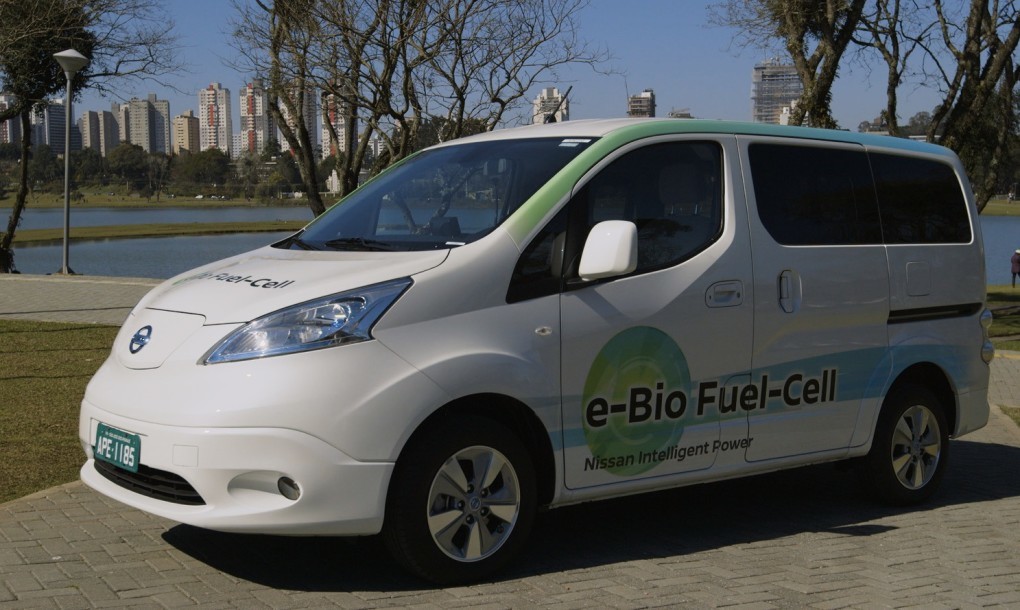
Nissan is the official sponsor of this summer’s Rio 2016 Olympics and, in addition to contributing a fleet of cars for the games, the automaker has revealed the world’s first solid-oxide fuel-cell vehicle. Nissan’s new e-Bio Fuel-Cell prototype doesn’t rely on hydrogen like today’s fuel cell vehicles and instead runs on ethanol and ethanol-blended water.
The e-Bio Fuel-Cell prototype vehicle runs on 100-percent ethanol or ethanol-blended water to charge its 24kWh battery that gives the fuel-cell van a cruising range of more than 373 miles. If the prototype looks familiar, it should since the e-Bio Fuel-Cell is based on the e-NV200. According to Nissan, it chose to create the e-Bio Fuel-Cell prototype because bio-ethanol fuels, which are mainly sourced from sugarcane and corn, are widely available. Due to the easy availability of ethanol and ethanol-blended water, the system is not heavily restricted by the existing charging infrastructure, making it easy to introduce to the market.
Nissan president and CEO Carlos Ghosn stated: “The e-Bio Fuel-Cell offers eco-friendly transportation and creates opportunities for regional energy production…all the while supporting the existing infrastructure. In the future, the e-Bio Fuel-Cell will become even more user-friendly. Ethanol-blended water is easier and safer to handle than most other fuels. Without the need to create new infrastructure, it has great potential to drive market growth.”
Nissan will conduct further field tests on public roads in Brazil using the prototype.
Article by Marc Carter at inhabitat.com
Read more interesting news by Marc Carter at inhabitat.com
Read more interesting news by Marc Carter at inhabitat.com