
RECOMMENDED VIDEOS
Bottlecycler Glass Management
BottleCycle Glass Management
Gold & Silver Refining Systems
Process Machine
Degremont - Sustainable Water Management Solutions
Degremont (Malaysia) Sdn Bhd
Steinert Australia : UniSort Flake Sorting - Magnetic Separation…
Steinert Australia Pty Ltd

SJTU Sewerage Treatment
Ronser Bio-Tech Bhd
Related Stories
First paper straw factory in decades to open as UK bans plastic
GREEN CITIES INVESTMENT FORUM 2024
Beach plastic audit in the Philippines reveals which businesses are the worst polluters
Made from sewage, these “popsicles” reveal the scale of Taiwan’s water pollution
World’s first mobile recycling plant turns trash into tiles
30 Aug, 2016

Tokyo Olympic medals to be made from e-waste
Resource Recovery & Environment Management | JAPAN | 30 Aug, 2016
Published by : Eco Media Asia
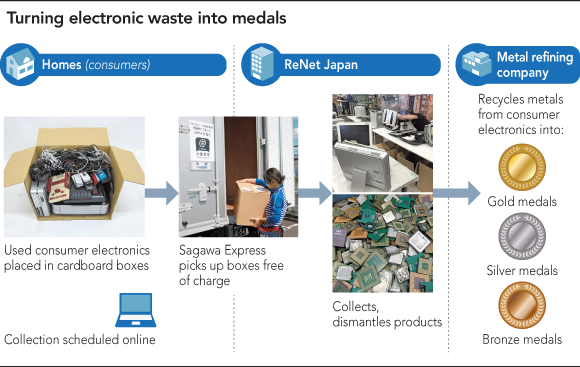
TOKYO -- Organizers of the 2020 Tokyo Olympics are hoping to source the gold, silver and bronze needed to make medals for the games by tapping the country's "urban mine" -- made up of millions of discarded smartphones and other small consumer electronics.
Such electronic waste contains enough precious metals to produce all the medals for the Olympic and Paralympic Games to be held in Japan's capital four years from now, according to a group of Olympic organizers, government officials and company executives that discussed the proposal in June.
For the 2012 London Olympics, 9.6kg of gold, 1,210kg of silver and 700kg of copper -- the primary component of bronze -- were used to produce medals. In comparison, the amount of precious metals recovered from discarded small consumer electronics in Japan in 2014 included 143kg of gold, 1,566kg of silver and 1,112 tons of copper.
While Japan is poor in natural resources, its "mine" of gold and silver contained in small consumer electronics is equivalent to 16% and 22% of the world's total reserves, respectively -- surpassing the reserves of any natural resources-abundant nation.
Olympic host cities usually procure metal for medals largely by asking mining companies to donate them.
The idea of using recycled electronics was discussed at a June 10 meeting in Tokyo to consider "cooperation proposals for the Tokyo 2020 operation plan" with an eye toward a "sustainable future." Participants included officials of the Tokyo Olympic and Paralympic organizing committee, the Ministry of the Environment and the Tokyo Metropolitan Government, as well as executives from mobile phone company NTT DoCoMo, precious metals company Tanaka Kikinzoku Kogyo, and recycling companies.
Collection challenge
One challenge is the fact that Japan has not fully implemented a system for collecting discarded consumer electronics. While about 650,000 tons of small electronics and electric home appliances are discarded in Japan every year, it is estimated that less than 100,000 tons is collected under a system based on the small home appliance recycling law, which came into force in 2013. The Environment Ministry has called on municipalities to target collecting 1kg of small consumer electronics per person per year, but many municipalities have fallen short of collecting even 100 grams per person.
In addition, much of the metal that is recovered is already being reused to make new electronics. Silver, in particular, faces a tight supply-demand balance, making it uncertain whether enough can be obtained to produce the Olympic medals.
By raising public awareness, the amount of electronic waste that is collected and recycled could be increased. Recycling is already widespread in Japan for many products, including milk cartons and plastic bottle caps, thanks to the efforts and cooperation of environmentally conscious consumers.
"We need a system that makes it easy for consumers to turn in used consumer electronics," said Takeshi Kuroda, president of ReNet Japan Group, an Obu, Aichi Prefecture-based company that purchases and sells used home appliances. ReNet is among the companies backing the plan to make Olympic medals from electronic waste.
"A collection system should be created by the private sector, and central and local governments should be in charge of publicizing such private services," Kuroda said. "If this public-private cooperation progresses, the collection of electronic waste should also progress."
Yuko Sakita, a representative of the nonprofit organization Genki Net for Creating a Sustainable Society, which organized the June 10 meeting, said: "In order for all Japanese people to participate in the Tokyo Olympics, we are asking companies to propose a concrete collection proposal and would like to work with the Olympic organizing committee to realize the proposal."
Article by Ken Sakakibara at Nikkei Asian Review