
RECOMMENDED VIDEOS
HMX-PCU-F: fresh air pre-cooling
A.T.E. Enterprises Private Limited

CAMSS™ 20Q Shelter with Energy Saving Accessories
CAMSS Shelters
Biomass Lisbjerg Power Plant
Burmeister & Wain Energy A/S

Energy Efficient PL LED Down Lights
Ilum-a-Lite
SunEdison Karadzhalovo 60 MWp Solar PV Plant
SunEdison
Related Stories
The City of London will be powered with 100% renewable energy by October 2018
The largest solar farm apiary in the US opens this week
New study suggests that plastic waste may be transformed into usable energy
Uravu’s zero-electricity Aqua Panels produce gallons of water from thin air
104% of Portugal’s electricity consumption in March came from renewable energy
09 Sep, 2016

How sun, salt and glass could help solve our energy needs
Renewable Energy & Energy Efficiency | UNITED STATES | 08 Sep, 2016
Published by : Eco Media Asia
It looks like a set from a sci-fi epic, but this solar plant in the scorching Nevada desert has a far more practical purpose…
High in the stark Nevada desert, a couple of hundred miles north-west of Las Vegas, is the shimmering circular mirage of Crescent Dunes. Ten thousand silvery glass panes, each measuring 115 square metres, surround a tall central tower, which stands like a twinkling needle in the featureless landscape around it. Resembling a fabulous alien metropolis, Crescent Dunes is in fact a highly sophisticated, mile-and-a-half-wide solar power plant – “the next generation in solar energy”, according to Kevin Smith, one of the project’s founders.
The glass panes, which comprise a combined area of more than a million square metres, are not photovoltaic (PV) panels like those installed on rooftops and in solar farms worldwide. Instead, they are simply vast, multifaceted mirrors, which track the course of the sun like heliotropic plants. This field of mirrors harnesses and concentrates the blazing Nevada sunshine, directing it precisely towards the top of the central tower.
It’s really an alternative to fossil fuel or even nuclear - Kevin Smith, CEO of SolarReserve
“The difficulty with photovoltaic is that it’s intermittent,” says Smith, who is CEO of Crescent Dunes’s parent company, SolarReserve. “When the sun goes down, you’re done.” Engineers have long sought methods of storing solar energy – in water, in batteries, in fluid-filled “parabolic troughs” – but Smith claims that Crescent Dunes demonstrates “the world’s most advanced energy-storage technology”, known as molten-salt storage.
The central tower secretes a reservoir of potassium and sodium nitrate – about 25,000 metric tonnes of it – heated in advance to 288°C, at which temperature the mixture is a clear, water-like liquid. This is circulated in narrow, thin-walled tubes, rising dramatically in temperature when exposed to the fearsome, concentrated sunlight at the top of the tower. “We heat it to 560°C,” says Smith, “it flows back down the tower and we capture it in a large tank.”
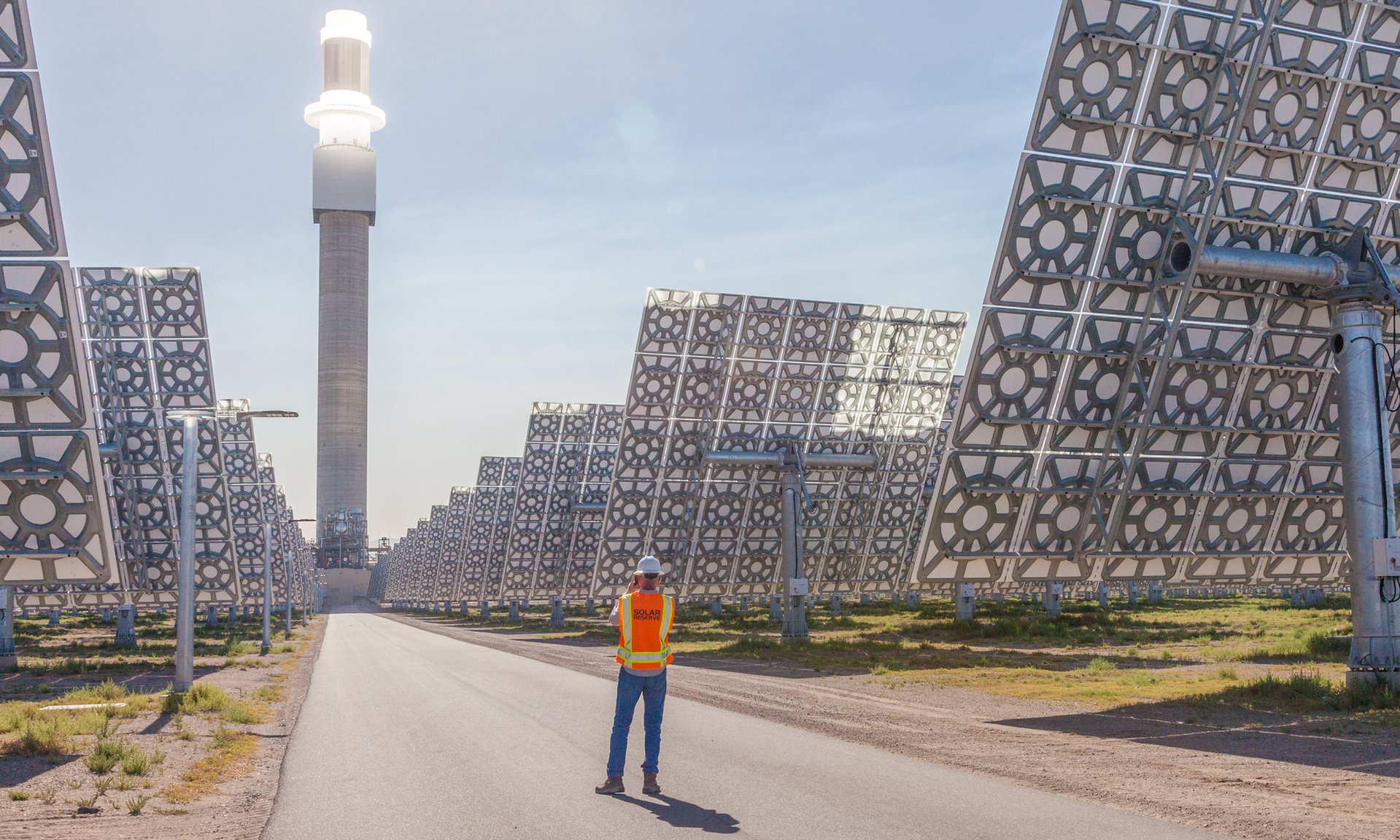
Crescent Dunes Photograph: Pedro Alvarez for the Observer
The molten salt efficiently maintains the heat and when the energy is required, it is converted to electricity through a conventional steam turbine. This set-up allows Crescent Dunes to provide power to 75,000 Nevada homes long after the sun has set and even, if necessary, 24 hours a day.Smith believes that concentrated solar power (CSP) is not simply a substitute for photovoltaic panels but a potential competitor to conventional fuels. “It’s really an alternative to fossil fuel or even nuclear. You couldn’t power a city with just PV and wind, but you could with CSP, because of the storage capacity.” SolarReserve is already developing cheaper, higher-capacity installations and planning to build similar solar plants in South Africa, Chile and China.
Of course, the technology isn’t flawless: CSP can only efficiently operate in areas with intense, uninterrupted sunlight and birds can be burned and killed by the concentrated sunbeams. Nonetheless, Crescent Dunes emits no pollutants, uses a fraction of the water required to generate coal or nuclear power and occupies a smaller combined area than, say, a coal-fired power station. Assuming the technology proves sustainable and replicable, among the ancient mountains of the American west, a bright future may be under way.
Article by Kit Buchan at The Guardian
Lead image : A fabulous alien metropolis’: Crescent Dunes in Nevada. Photograph: Pedro Alvarez for the Observer